
Home / Case studies / Hazardous hole deployment
Tech-Log™ · Underground · safety
Televiewer images
from hazardous holes
Unstable underground boreholes were being excluded from televiewer logging because the risk of losing the tool was unacceptable. An armoured carrier that houses the televiewer on the end of the drill string cut that risk enough to log a 200 m dry up-hole and reopen programmes previously labelled hazardous.
The question
Acoustic and optical televiewers have become a staple of geotechnical evaluation in surface and underground drilling programmes. In a growing number of cases, however, formation stability concerns precluded acquiring image data: the holes were deemed too dangerous to enter, with the risk of equipment loss beyond acceptable limits.
Although not limited to underground boreholes, this concern saw underground logging programmes restricted to "safe" holes or terminated altogether, with the loss of valuable litho-structural data and any downstream interpretation based on it. A robust risk-management solution was required that, if not eliminating the risk, would limit it to acceptable levels.
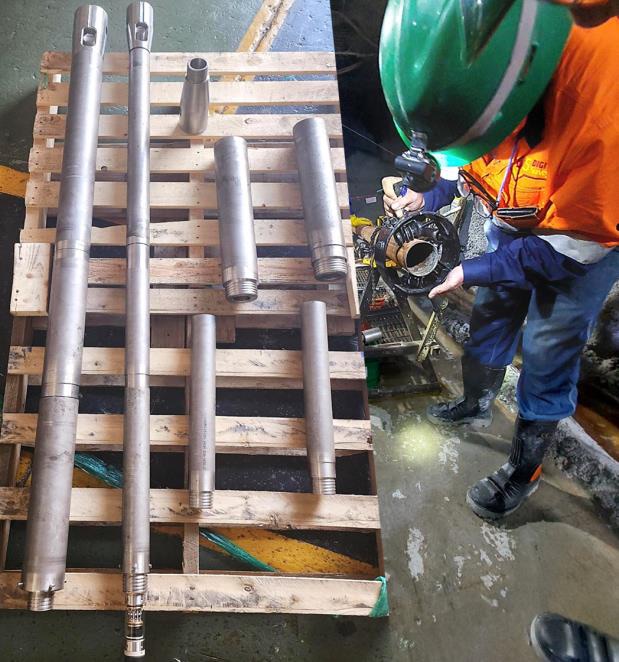
A drill-string-deployed armoured carrier protected the televiewer from collapse and obstructions and kept a rigid connection for retrieval, so oriented images were captured from holes that would otherwise have been written off.
- SystemArmoured televiewer carrier deployed on the drill string
- SizesNQ and HQ hole diameters
- ProtectionImaging-head cage engineered to limit image artefacts
- ExampleOTV image section from a 200 m dry up-hole
What we did
Digital Surveying developed a hazardous hole deployment system for televiewers that significantly reduces the risk of tool damage or loss. Housing the televiewer in an armoured carrier on the end of the drill string has a major risk-reduction advantage over standard cable or push-rod deployment: the tool is protected from borehole collapse and existing in-hole obstructions, and the high-strength rigid connection makes retrieval in the event of collapse far more likely.
The imaging-head protection cage was specifically engineered to offer maximum protection to the tool while introducing as few image artefacts as possible. Because accurate interpretation of image features requires borehole diameter, the system is adaptable to house a three-arm caliper, which requires a second run.
Both the ATV and OTV orient their images with an onboard fluxgate navigation system, so a gyroscopic deviation survey is advisable in the same hole to correct image orientation for any magnetic artefacts introduced by the drill string or the formation in non-vertical sections.
What it changed
The system greatly reduces the risks associated with televiewer data acquisition in underground boreholes with formation stability issues, redefining what is possible for programmes previously labelled hazardous. More data in the downstream decision-making process enables safer operations through better-designed interventions, reducing the likelihood of fall-of-ground and rock burst events. Deployment on the drill string also makes image capture in long shallow-dipping, horizontal and up-hole boreholes easier and safer.
- Fully oriented OTV imagery from a 200 m dry up-hole
- Tool loss risk reduced to acceptable levels in unstable ground
- Programmes previously terminated as hazardous can now be logged
- Easier logging of long, flat and up-hole boreholes as a by-product
The acoustic televiewer images the wall with ultrasonic pulses, mapping acoustic impedance and hole diameter; the optical televiewer records a continuous, oriented true-colour image in air or clear fluid and can replace litho-structural core logging, with superior results in zones of core loss or breakage. In the carrier, longitudinal artefacts from the carrier arms are the only trade-off.