
Home / Case studies / BMR for CCUS
Hydro-Log™ · CCUS · reservoir
In-situ porosity and permeability
for CO₂ storage
A CO₂ storage site needs a porous, permeable reservoir sealed above and below. Borehole magnetic resonance measures the water in the pore network directly, giving continuous in-situ total porosity, free and bound fluid, permeability and hydraulic conductivity without laboratory matrix assumptions.
The question
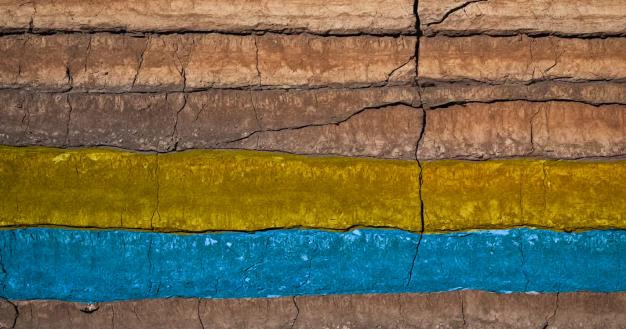
Carbon capture, utilisation and storage (CCUS) seeks to reduce the climate impact of CO₂ emissions by capturing the gas and storing it in subsurface reservoirs. Like any gas project, CCUS requires a structural trap: a porous, permeable layer bounded by impermeable upper and lower layers that form the seal. Candidate sites include non-producing oil and gas reservoirs, deep coal seams and saline aquifers.
Site evaluation must consider the effectiveness of the seal along with the porosity, permeability and pore distribution of the reservoir. That evaluation has primarily relied on laboratory porosity measurements from core samples, which are costly and time-consuming, limited in number, randomly distributed along the hole, and dependent on core condition.
Petrophysical porosity from density (DPOR) or P-wave velocity (SPOR) depends heavily on applying the correct matrix coefficients, and any lateral or vertical variability in those coefficients must be accounted for. Packer testing has been used with varying success, largely dependent on correct packer placement, which itself needs prior information such as wireline logs.
BMR delivered continuous, in-situ porosity and permeability along the whole hole at reasonable cost and short turnaround, adding a level of certainty to the reservoir model that discrete core tests could not.
- ApplicationCCUS reservoir and seal characterisation
- ToolSlimline borehole magnetic resonance (BMR)
- MeasuresTotal porosity, bound and free fluid, permeability, hydraulic conductivity
- AdvantageContinuous, in-situ, independent of lithology and matrix coefficients
What we did
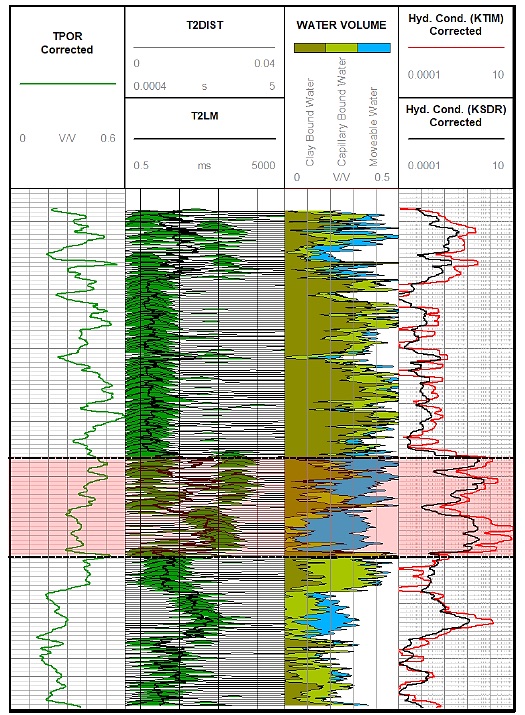
Borehole magnetic resonance is a downhole geophysical tool that accurately measures the water contained within the formation. It is specifically tuned to sense fluids within the pore network, enabling precise determination of total porosity along with bound and free fluid content. Formation permeability and hydraulic conductivity are derived without the need for other wireline log data.
Because BMR decomposes total porosity into fluid volumes of different mobilities, the drainable porosity can be estimated as a primary output of the log.
Although BMR data is useful as a stand-alone data set, combining it with other wireline logs such as density, sonic velocities and acoustic televiewer imaging greatly enhances the combined physical-property interpretation of the intersected formations. BMR porosities can also be empirically modelled against laboratory core measurements to fine-tune local and borehole-specific influences.
What it changed
The usefulness of BMR logs for CCUS studies has been recognised for many years for their ability to acquire continuous, in-situ porosity and permeability data at reasonable cost and with shorter turnaround on results. Because the data is measured in-situ and continuously, it adds a level of certainty to the final models and interpretations that was not achievable before.
- Continuous total porosity with bound and free fluid split along the hole
- Permeability and hydraulic conductivity without other log inputs
- Drainable porosity as a primary log output
- Calibration against core where lab data exists
BMR measures the spin of hydrogen protons in water. Permanent magnets on the tool create a static field that aligns the hydrogen nuclei; antennae transmit precisely timed radio-frequency pulses that push them out of alignment. As the protons relax they emit a signal whose initial strength is proportional to the total water present, and whose T2 relaxation time indicates pore size: long times mean large pores and mobile water, short times mean small pores and bound water.