
Home / Case studies / BMR for lithium brines
Hydro-Log™ · Lithium · brine mining
Borehole magnetic resonance
for lithium brines
Brine mining economics hinge on how much brine is mobile and how fast it flows. Slimline borehole magnetic resonance measures total porosity, specific yield, specific retention and permeability directly in the hole, independent of lithology, at logging speeds of a metre per minute.
The question
Brine mining extracts minerals naturally dissolved in brine, from shallow brines beneath saline or dry lakes to deep brines in sedimentary basins. Brines are pumped to surface into evaporation ponds and are important sources of potash, lithium and other metals and industrial salts. Lithium supply underpins the battery economy, with demand expected to soar; potash is crucial to feeding a global population expected to exceed nine billion by 2050.
Hydrogeology plays a critical role in the economic viability and development strategy of a brine operation. To assess the distribution and producibility of groundwater brines, the hydrogeologist must determine vertical and lateral variation in total porosity across the resource, and separate the fraction occupied by free (mobile) brine from the fraction occupied by bound (immobile) brine. Mapping brine movement requires hydraulic conductivity, specific yield and specific retention.
These properties can be measured on clean, dried core plugs, but accuracy suffers from core quality, filtrate invasion, damage on retrieval, poor preservation, scaling effects and test method. Density-log porosity is prone to error if matrix density is not precisely known, permeability cannot be measured directly and relies on lithology-dependent correlations, and packer tests can take hours or days for a single measurement.
Lithology-agnostic BMR gave the hydrogeologist a continuous in-situ profile of total porosity, mobile and bound brine and permeability, replacing sparse core plugs and day-long packer tests with a log acquired at a metre per minute.
- ApplicationLithium and potash brine resource evaluation
- ToolSlimline borehole magnetic resonance (BMR)
- MeasuresTotal porosity, specific yield, specific retention, permeability
- Logging speedAbout 1 m/min, continuous, rig-less and crane-free
What we did
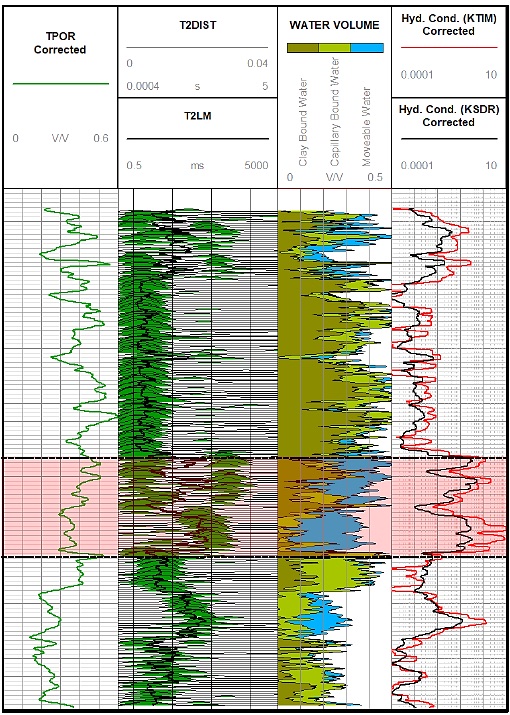
Total porosity, specific yield and specific retention can all be measured directly in-situ using borehole magnetic resonance, which is specifically tuned to sense the fluid-filled pores only. Measurement accuracy is therefore relatively unaffected by matrix composition, in complete contrast to the lithology-dependent principle of conventional logging tools.
BMR has been routine in oil and gas logging for decades, but uptake in brine mining was hindered by tool size. Slimline BMR tool development closed that gap. Advanced pulse sequences and signal processing determine aquifer pore structure and mobile water content with high precision and accuracy, and an appropriate theoretical model estimates intrinsic permeability.
Ultrafast wireline telemetry and advanced analysis software produce a detailed log of these hydrogeological parameters. Despite miniaturisation, the tool has a high signal-to-noise ratio and a large depth of investigation, so variation through the aquifer is mapped while logging continuously at about 1 m/min.

What it changed
Continuous, in-situ porosity and permeability data at reasonable cost and short turnaround adds a level of certainty to brine resource models and interpretations that was previously unachievable. Compared with packer testing and core logging, BMR is in-situ, accurate, splits porosity into free, clay-bound and capillary-bound fractions, delivers permeability, real-time data and a continuous profile, and runs rig-less and crane-free at the lowest test cost of the three.
- Total porosity split into free-water, clay-bound and capillary-bound fractions
- Specific yield and specific retention read directly in-situ
- Permeability and hydraulic conductivity along the whole hole
- Lowest cost and highest cost-benefit of packer testing, core logging and BMR
BMR measures the spin of hydrogen protons in the brine. A static magnetic field from the tool's permanent magnets aligns the nuclei; radio-frequency pulses knock them out of alignment; as they relax they emit a signal proportional to the water present, with relaxation time indicating pore size and fluid mobility. Because only fluid-filled pores respond, the measurement is independent of rock matrix.