
Home / Case studies / BMR for uranium ISR
Hydro-Log™ · Uranium · in-situ recovery
Borehole magnetic resonance
for uranium in-situ recovery
In-situ recovery only works if the ore sits in a permeable aquifer sealed above and below. At a sandstone-hosted uranium deposit in South Australia, borehole magnetic resonance measured porosity and permeability directly, confirmed the host aquifer and its bounding aquitards, and reduced the need for early pumping tests.
A partner study by Jordan McGlew, Nick Jervis-Bardy and Jonathan Ross of Orica Digital Solutions, with Andrea Marsland-Smith and Philip Mill of Alligator Energy. Data from the Samphire project.
The question
In-situ recovery (ISR) circulates a leaching solution through the orebody, using groundwater flow to carry it, and recovers the dissolved metal at the surface. It is among the most sustainable and economical ways to mine, is used for uranium, copper and potash, and accounts for about two thirds of the world's uranium production.
ISR only works if the ore sits in a formation permeable enough for the solution to flow through easily, with low-permeability confining layers above and below. Pore volume, calculated from effective porosity and permeability, sets the quantity of solution and the time the wellfield will take. Conventionally this information comes from core and pumping tests, both slow and costly; at the exploration stage pumping tests are not viable at all, because they need a network of wells.
BMR measured porosity and permeability directly, confirmed that the uranium sits in a permeable aquifer bounded by aquitards, and showed the deposit suits in-situ recovery while reducing the need for early pumping tests.
- DepositSandstone-hosted uranium in the Kanaka sands, an Eocene palaeochannel
- ToolBorehole magnetic resonance (BMR)
- MeasuresTotal porosity, free and bound fluid, permeability, hydraulic conductivity
- ResultHost aquifer and bounding aquitards confirmed
What we did
The BMR tool works on the same principle as a hospital MRI scanner, except that it looks outwards into the rock. It measures the hydrogen in the pore water as a continuous log, giving total porosity, the split between moveable and bound water (effective porosity), and an estimate of how easily water will flow (hydraulic conductivity).
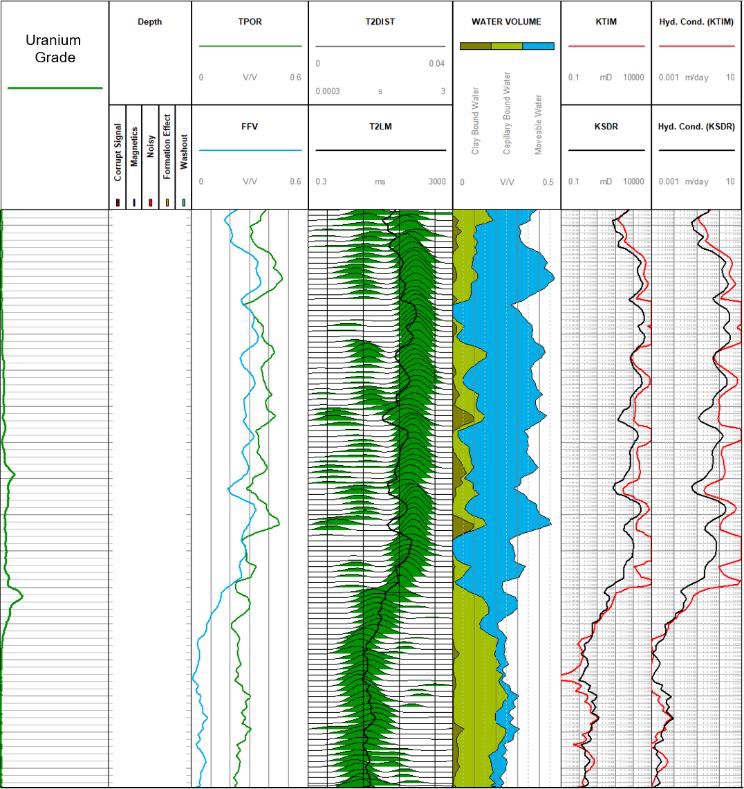
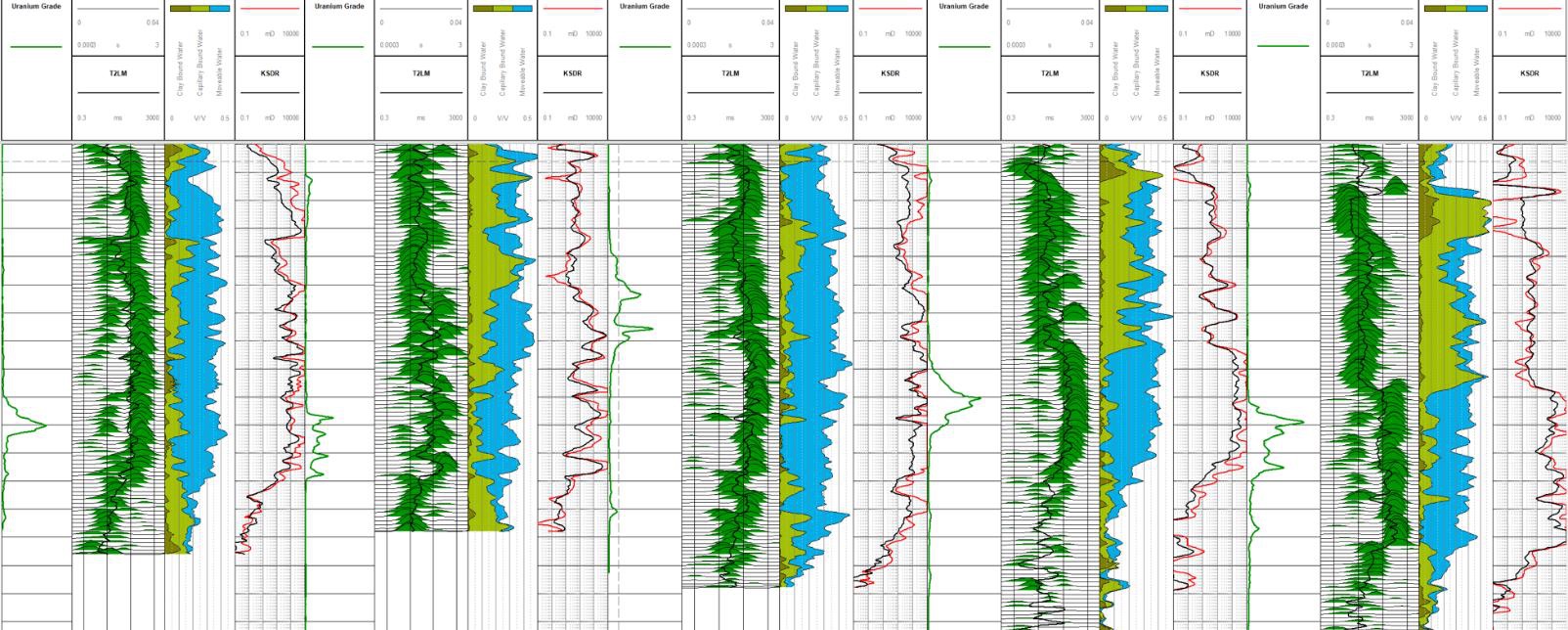
The uranium at Samphire is hosted in the Kanaka sands, an Eocene palaeochannel of fine to coarse-grained channel and floodplain sands, with the target uranium in the coarse sands. BMR logs were run alongside the uranium grade, and correlated across the field in a cross-section.
What it changed
Where the uranium grade is high, the BMR shows high porosity, high permeability, large volumes of moveable fluid and long relaxation times, meaning large pores: the deposit lies within the target palaeochannel and aquifer. Above and below it, permeability falls and shorter relaxation times show smaller pores with water held in capillaries and clays, the aquitards that bound the future mining zone.
Previously, porosity and permeability were qualitative, estimated by geologists or from electrical logs affected by the chlorides in the groundwater. BMR gave direct, lithology-independent porosity and quantitative permeability, which gave confidence that the target sits in permeable sands and could be demonstrated to the market. It also reduced the need for pumping tests at this stage and narrowed down where they would be most useful later.
- Deposit confirmed as amenable to in-situ recovery
- Host aquifer and confining aquitards identified quickly
- Quantitative permeability in place of qualitative estimates
- Fewer pumping tests, better targeted
Permanent magnets on the tool align the hydrogen nuclei in the pore water; a radio-frequency pulse tips them over and, as they relax back, they emit a signal. The starting signal strength gives total porosity; the relaxation time (T2) depends on pore size, so long times mean large pores and freely moving water, short times mean small pores and water bound in capillaries or clay. Permeability follows from the porosity and the T2 distribution.