
Home / Case studies / Local hazard index
Synthesis™ · Geohazard · formation evaluation
A log-derived
local hazard index
At Tumela Mine, where mining has advanced to 1.3 km on reefs dipping 18 to 27 degrees, borehole geophysical logs were compared with laboratory stress-strain tests to build a robust workflow and a local Hazard Index: one log that flags zones of potential hazard for shaft sinking, slope stability, hydrogeology and ahead-of-mining studies.
The question
The Bushveld Igneous Complex in Limpopo Province, South Africa, contains major structures known to pose a threat to mining operations. Tumela Mine is a large underground and open-cast operation with mining rights covering 111 km². With shallow Merensky Reef resources depleted, mining has advanced down-dip to exploit both the pyroxenite Merensky and chromitite UG2 reefs, and now operates at depths of 1.3 km. The reefs are narrow tabular orebodies extending for hundreds of square kilometres and dipping 18° to 27° south-east.
Mine planning and development suffer the cost and scheduling impact of intersecting high-geohazard zones. Health and safety risk directly associated with geohazard is a critical parameter in the design and execution of hard-rock mining, in both open-cast and underground environments, and is often difficult to evaluate.
A robust local Hazard Index derived from borehole geophysical logs identifies zones of potential hazard and feeds directly into shaft sinking, slope stability, hydrogeology and ahead-of-mining studies, increasing confidence, de-risking development and fast-tracking mining.
- SiteTumela Mine, Amandelbult area, Limpopo, South Africa
- DepthMining at 1.3 km on Merensky and UG2 reefs dipping 18° to 27° SE
- LogsTeleviewer, sonic and density, flowmeter, BMR, fluid temperature and conductivity, low-frequency radar
- OutputHazard Index log: a linear combination of borehole parameters flagging hazard zones
What we did
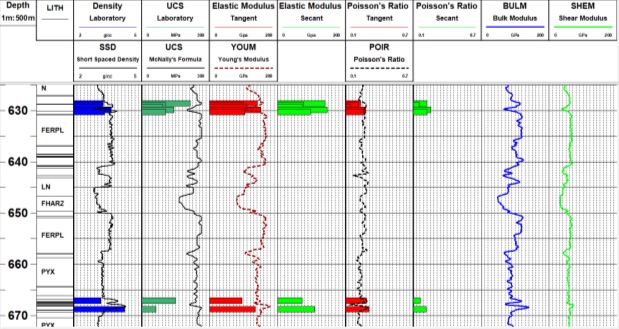
Borehole geophysical logging has gained momentum as part of detailed investigations to characterise formations structurally and geotechnically. Borehole televiewers are routinely used to capture structural and geotechnical data, providing accurate, fully oriented parameters for features intersected by the hole. In-situ rock strength is derived from sonic velocity and density. For hydrogeological applications, analysis of impeller flowmeter, borehole magnetic resonance, fluid temperature and fluid conductivity locates associated fractures, aquifers and fluid passageways.
These log-derived parameters were compared with laboratory stress-strain test work. Because most logging information is limited to the borehole wall, low-frequency radar was employed to detect the lateral extent of major structures, with the capacity to map structures more than 50 m from the borehole depending on formation.
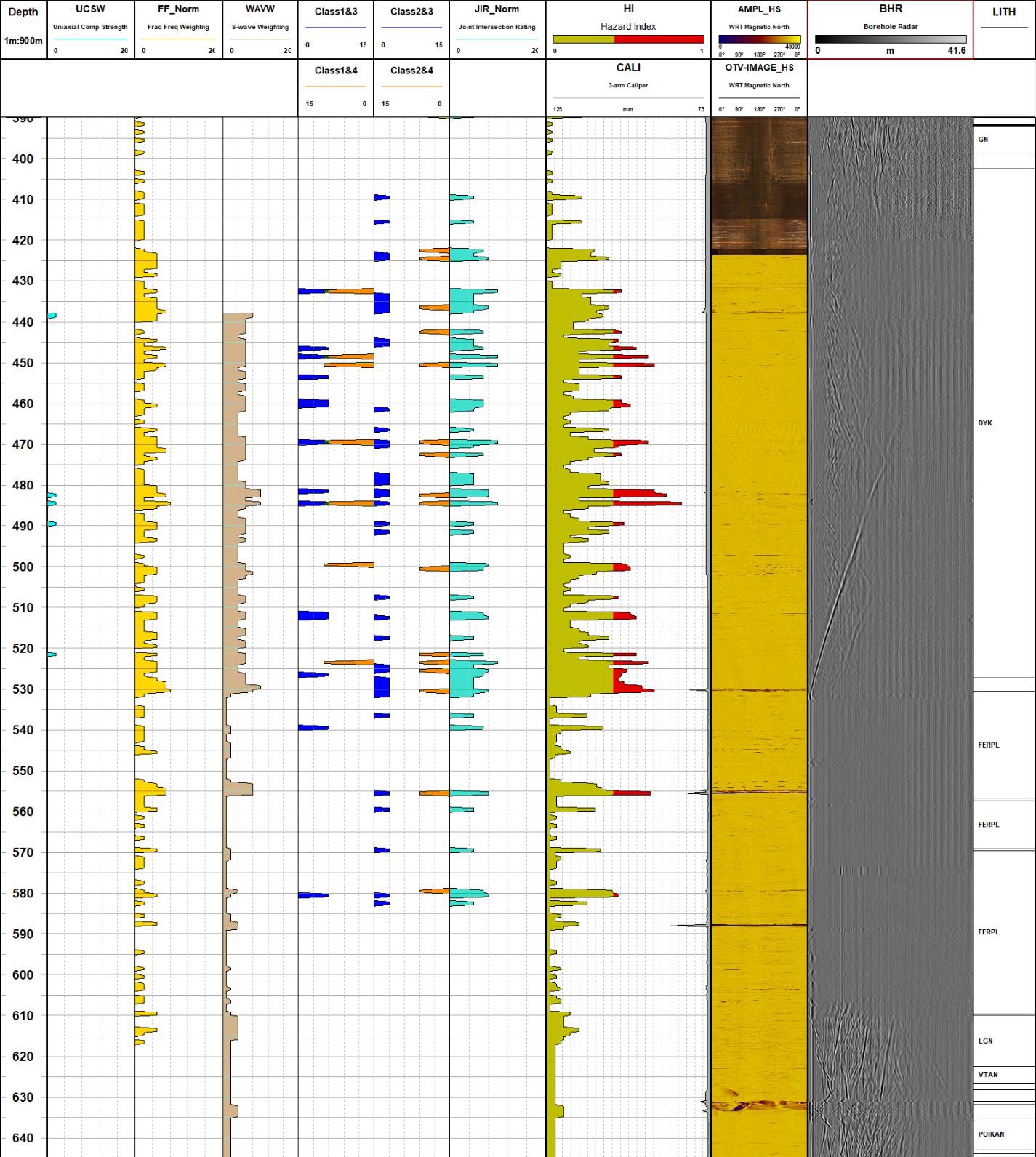
The Hazard Index log is a risk assessment tool that combines multiple borehole parameters or logs linearly into one log, similar to well-known rock mass classification schemes, to flag zones of potential hazard.
What it changed
The robust local Hazard Index derived from borehole geophysical logs identifies zones of potential hazard. This information is integrated into shaft sinking, slope stability, hydrogeology and ahead-of-mining studies, increasing confidence in plans and de-risking developments, ultimately reducing cost and fast-tracking mining. Elevated-hazard zones in the index correspond to structural elements mapped in the acoustic televiewer and the radargram.
- One Hazard Index log in place of a dozen separate curves
- Log responses calibrated against laboratory stress-strain results
- Structures traced more than 50 m off-hole with low-frequency radar
- Direct input to shaft sinking, slope stability and ahead-of-mining decisions
Each contributing log measures a different control on hazard: televiewers give fracture orientation and frequency, sonic and density give dynamic strength, flowmeter, BMR and fluid logs give fluid pathways, and radar gives lateral extent. Comparison with stress-strain tests sets the weights; the weighted linear combination is plotted as a single index log with thresholds for elevated hazard.