
Home / Case studies / Kariba Dam
Tech-Log™ · Dams · geotechnical
Kariba Dam plunge pool
rehabilitation
Decades of spill-gate flow eroded the natural rock floor of the Kariba Dam plunge pool. Oriented optical and acoustic televiewer images from short cored holes gave the rehabilitation project the fracture, foliation and rock-hardness evidence its excavation and slab design needed, faster than core logging alone.
The question
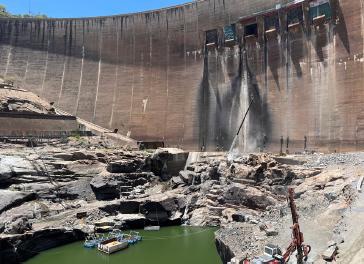
Over the years, water flowing through the spill gates of the Kariba Dam eroded the natural rock floor of the plunge pool. The Kariba Dam Rehabilitation Project (KDRP) was created to reshape and rebuild the plunge pool, limiting erosion of the riverbed directly beneath the dam wall and securing the dam's future operation to international standards.
The works involve excavating 300 000 m³ of rock from the current pool and constructing a concrete slab to protect the weakest areas. Work commenced in 2017 with completion expected by the end of 2024.
A geotechnical investigation was needed to answer the engineering questions behind the excavation and rehabilitation: the geomechanical characteristics of the rock mass in terms of fracturing, weathering, alteration, hardness, strength and deformability. Those characteristics bear directly on project scope, cost and success.
Fully oriented, high-resolution televiewer images gave the rehabilitation team a detailed digital structural data set in less time than core logging, with fracture openness and rock-hardness proxies that core alone could not supply.
- SiteKariba Dam plunge pool, biotite gneiss bedrock
- Scope300 000 m³ rock excavation and protective concrete slab
- ToolsOptical televiewer (OTV) and acoustic televiewer (ATV)
- DeliverableOriented fracture, bedding and foliation data set, fracture openness, acoustic reflectance index
What we did
A watertight coffer dam was constructed so that a series of short, cored holes could be drilled into the biotite gneiss bedrock. Core retrieved from these holes was analysed in a laboratory, while in-situ measurements were made in the now-open holes.
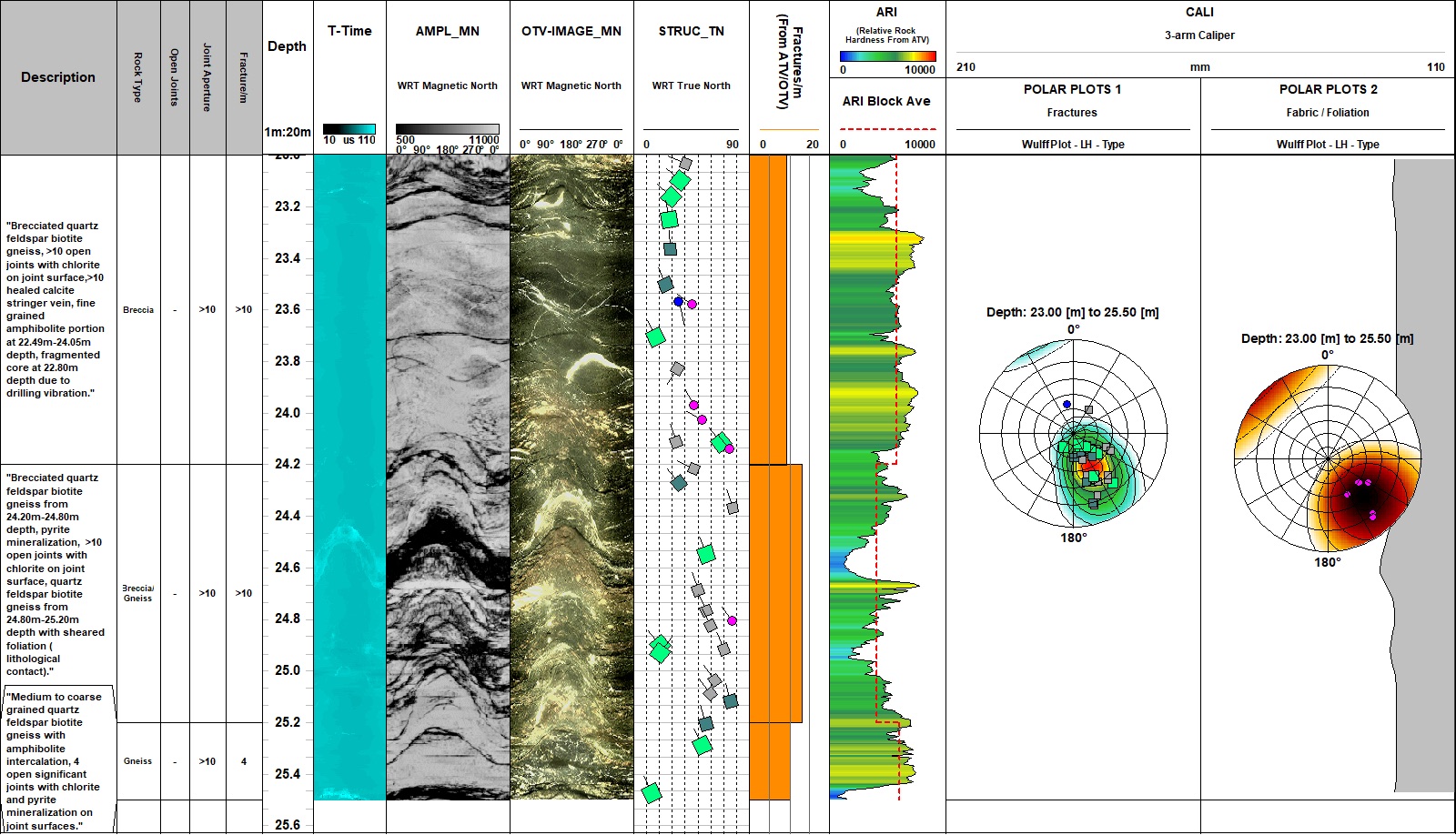
An important component of the in-situ testing was the analysis of fracture distribution and orientation, together with bedding and foliation orientations, within the bedrock. Both optical and acoustic televiewers were deployed downhole to capture high-resolution, oriented images of the undisturbed borehole wall.
Because the images are captured directly from the relatively undisturbed wall rock, fracture openness could be measured as part of the interpretation classification, which is not always possible, or carries higher uncertainty, from core samples alone. The acoustic reflectance index (ARI) was extracted from the ATV amplitude image as an uncalibrated but useful metric of rock-hardness variability in the wall rock.
What it changed
In the hands of an experienced interpreter, the in-situ ATV and OTV images yielded a highly detailed digital point data set in a shorter time than it traditionally takes for core logging results to be published. This sped up decision-making, assisted in siting extra boreholes where required, and highlighted areas of concern faster.
- Oriented fracture, bedding and foliation orientations for the plunge pool rock mass
- Fracture openness measured in-situ, not inferred from core
- Acoustic reflectance index as a continuous rock-hardness proxy
- Structural data delivered ahead of the core logging schedule
The acoustic televiewer transmits ultrasound pulses from a fixed transducer via a rotating mirror and records the amplitude and travel time reflected at the borehole wall; amplitude maps acoustic impedance and travel time maps hole shape. The optical televiewer scans the wall optically and delivers a continuous, oriented true-colour image in clear fluid or air, usable as a replacement for litho-structural core logging.